Monday, February 10, 2014

Acceleration


Hello!
Today, I am going to talk about acceleration. The one I did previously is motion, which is quite similar with this today's topic.
What is acceleration? Acceleration is the change in velocity divided by the time it takes for the change to occur. This is the definition.

There are three ways of acceleration. It is speeding up, speeding down and changing direction.
Let's start talking about those.
Speeding up means speeding up. It is the other word for accelerating. Accelerating happens only when the motion and the velocity are in same direction. If the ball rolls to the right side and tend to go right side, acceleration will happen. Example of down hill is one of the same direction. You roll the ball down hill and it will accelerate as it goes down. This is also called positive acceleration.
Next, it is slowing down, also deceleration. Opposing speeding up, it happens when motion and velocity is going on the opposite direction. Up hill is another example. When you roll up the hill, the motion is forward. but because of the gravity, it tends to go backward. So motion and velocity is opposite way. This is also called negative acceleration.
 There is a way to calculate acceleration. It is
(Final Speed-Initial Speed) / time. To think easier, I will give you an example. Lets say that you went down the slide. The starting speed (initial speed) will be 0m per seconds .10 seconds later, the speed was 20m per seconds. So now you just need to put the numbers in.
(20m per second-0m per second) /10second. This leaves 2m per s^2.
Acceleration has s^2 always.
Next, there is a graph of acceleration. The bottom line is time, and on the side is meter. When graph rises, it means it has acceleration. But when the slope is downward, it means it is slowing down. When the graph is constant, with no slope, means the speed is constant, nor slowing down or slowing up. There is one method my science tought us about the graph. When the graph has a smily face, it means it is positive graph, and when it is having opposite smiling graph form, it means negative acceleration. This really makes it easy to memorize.

negative graph over here, red line is the negative graph that shows it slows down from 8th seconds.


Wednesday, January 29, 2014

Motion

Hello everyone, long time no post! I came back with a topic "Motion". I know that you all have heard of it or even know what it is. For the people who don't know, I will talk about it today. As I start as usual, what is motion?

Motion is any movement or change in position or time. For example of motion of your body, standing up and down, blood circulation, and stomach going up and down while you are breathing are the ones. There are a lot more examples, but I am not listing thousands of them here.

 I have many things to talk about.


First, what is relative motion?'

Relative motion is when an object changes position moving relative to a reference point. So let me give you an example. When I am on a train and let’s say the train is moving forward. Outside on the window, you will feel everything out there going backward instead of you on the train, going forward. On your reference point, it will be outside that goes backward and you staying still.
relative motion
 Next thing you will learn is distance and displacement. I bet you know what distance is but not displacement, but the people who don’t know what it is…
Distance is the measurement of the path you take to get to the finish. There a lot of units to show the distance, for instance, there are mm, cm, m, km, inch, feet, and yard. Many countries use mm, cm, m, km as a main units, but in U.S we use all, which kind of drives me crazy. Just to make sure you know, there are much more units used in the distance. If I give you an example, let’s say there is 100 m race in school. You know what? As it says, the distance is 100 m. Isn't it so simple?
 
d is the displacement between (x1,y1) and (x2,y2)
Since it is easy, I will explain what displacement is now. Displacement actually includes the distance, and it is the distance between the starting and ending points and the direction in which you travel. Let’s say you are late for something. You want to go faster than it usually takes, right? Maybe you can go shortcut without going all the way around something between you and the place you want to go. The shortcut is the displacement in an easy word to displacement. You go directly to the ending point. What you need to know additionally is that displacement can be 0 even though distance is not 0. So, when you come back to the spot where you had went off, I mean you go round and come back to starting line, displacement is 0.
 
speed
Next, we are going to learn about speed. I know that you know speed because it appears a lot of time our lives. It comes out on the computer game, on the road “speed limit” or in science and in math a lot, everywhere. Do you know the definition of the speed? Okay,  the speed is the distance an object travels in a unit of time. You can calculate the speed too. It is distance over time. This might confuse you, so I will explain it to you. Let’s say the car is moving 120miles in 2 hours, and let's say you want to figure out the speed of the car.Since the equation of the speed is distance/time, you just need to stick the numbers in, and it will be 120/2 which is 60. So the car is moving 60 miles per hour which is the speed of the car.
 Do you know the difference between velocity and speed? Many people think it is same. Well, that is what I thought too. You know what? They are different. Velocity is including the direction of the object, but speed does not. To give you the example, let's think that the car is moving toward NE and move toward south. In this case, you need to ask the velocity, not speed. That is the right word to say. But when the car goes in one way not thinking the direction it's going, you must say "Speed of the car" instead of velocity of the car.
 velocity
Next lets talk about type of speeds. There is instantaneous speed and average speed. They are both part of speed. For the example, the bike is going one place to another place. Let's say that the bike went 2 km in 100 seconds. The average speed will be the average speed of the bike from the distance first to the end, 2 km. The speed will be 2000/100 which is 20 m per second. But instantaneous speed is the a little different. This is the speed at the instant time. Bike won't go 20 m per second exactly at every moment. The person could have slowed down and speed up later. So instantaneous speed can be the speed of the specific moment also the speed from 5 m to 15 m can be instantaneous speed which can be 15 m per second.


These are the ones I wanted to explain to you today. I hope you understood even though I have a bad explanations. Thank you! 

Sunday, December 15, 2013

Issac Newton


    Hello, I am going to talk about Isaac Newton. Have you ever heard about him? If you haven't it will appear a lot in the future. Actually, you will learn about him during school. So, who is he? He is a gifted person in my opinion. He worked in science and math. Actually, he was great in science and math. He had made calculus, you know..
    Isaac Newton

     However, he has a sad story in his past. He was born in 1643, 1/4 at Woolsthorpe in England. He was born so small that nobody had expected him to stay alive. Newton's dad died three months before he was born, and I know it is sad because he couldn't see his son being called "The Father of Physics." Well, after Newton was born, mom had married the old guy, and Newton was sent to his grandmother. It is quite sad.. Actually, he almost become a farmer, but his uncle had convinced Isaac Newton's mother to let him go to Cambridge University.
     If I tell you about Newton's discovery through his life, even though he had a hard time in the past, he had worked in many things.
    cambidge university
    The first thing is that he had made CALCULUS. Calculus is the part of math learning in upper level. It is used to get the area of the irregular shapes like oval or something like that.
    The second thing he discovered is about the light. In the past, people had never thought that the white light is compound of red, orange, yellow, green, blue, navy, and violet. (In the future, optics and motions are discovered)  Also, he discovered that the light is made up of the particles.
    The third thing he discovered and defined is the laws of gravity.
    The fourth thing is that he defines  planetary motion.
    The fifth thing is that he defines three laws of motion. This describes that how all the universe act. This also explain how the gravitational force works. You know, Earth pulling the moon, and everything in the universe..
    The last is an invention. He invented a better telescope, a reflecting telescope. This telescope was using concave mirrors instead of lenses. This helped to look the object without loosing the original object's color.
    prism
     You know what? He had been other things other than a person sitting and defining things. He was a professor of mathmatics, Member of the Royal Society (He was president each year until his death), he was also knighted by the Queen Anne for his contribution, which led him to award a knighthood for scientific achievement. The most shocking thing is that he was really religious. You know, it is extremely rare to see a great scientist to be a deeply religious person because those spirits are hard to relate with science, but Isaac Newton was different, he was religious.
     Oh! Did I tell you that he attended Cambridge University but had to go back to Woolsthorpe where he was born, and than had to come back to University 2 years later? There were bubonic plague through London, killing huge number of people. That made Cambridge school to close, and made him go back. Actually, returning to his house was a good thing. The year he was working at home is called "Miracle Year" now. He had figured out laws of motion, forces and gravity/ discovery of light and optics/inventing a new branch of math Calculus. These things happened this time between 1655-1667. Surprising right?
    westminster abbey
     Newton died in 1727. He was buried in Westminster Abbey, and he was the first scientist to be awarded this high.
     So have you learn many things here? I hope you did, but if you think you need to learn more about it, click here!

    Sunday, December 8, 2013

    Heat

    Hello, I am back! Today I will talk about HEAT!!
    HEAT? What is that? Heat is the transfer of thermal energy from one object to another when two objects are brought into contact depends on the difference in temperature between the objects.
    You know what? You cannot survive without heat. Actually, none of the creatures can. Plants need heat to photosynthesis, animals need plants to survive, and us people need animal and plants to survive. Not only because we don't have food, we will die to freeze. There is a movie called "Tomorrow". The movie shows the people die from cold, I mean extremely cold. I recommend this movie!
     There are three ways of heat to be transferred. It is convection, condensation and radiation.
    AC/HEATER
    First, convection is the transfer of the thermal energy by the movement of atoms or molecules from one part of material to another. It is when the air or water become heated and rise up, the cold air or water falls back down where the heated air or water started from. If the cold air or water heats up again, it rises up and make the cycle. In real life, you can see convection when your mom boils the liquid to make food, or heating vent in the room can occur it. Did you ever wonder why air conditioner is high up near the ceiling and heating vent is at the bottom? It is because convection happens. If the air conditioner is at the bottom where heating vent is, the cold air won't rise up and try to stay on the bottom, and cycle won't work. Same reason as air conditioner, if heating vent is up in the room, where air conditioner is, hot air will try to stay up in the room. Oh, you know that convection occurs only with liquids or gas. What about solid? When the heat transfer occurs with solid, it is called conduction.
     Marshmallow conduction
    Conduction is transfer of thermal energy by direct contact. Not like convection, conduction occurs when the object is attached to the other object. For example, if you have a marshmallow and want to eat with the fire melting marshmallow, you have to stick the marshmallow on the stick and put directly in the fire. But!! if you feel that the stick is hot, you are holding a metal stick. The heat from the fire continuously heats up the the stick and the heat stretches out until where your hand is. So the heat from the fire touching the metal stick is called conduction. You might have not experienced burning your hand by melting marshmallow, and why is that? To be honest, market never sell metal stick for marshmallow so you don't  burn yourself. I don't really know what substance it is, but there are some that conduction doesn't happens easily. The substance is plastic, feather, and fur. They are poor conductors of heat, and the reason is because of the molecules' formation. Metals have uniformed closed molecules but the other substances I mentioned are having strip like arrangement. So the distance the heat can transfer is so far, and that is why.
     주택 - 태양열주택RADIATION
    The last, radiation is transfer of thermal energy without any object. The best example is the sun. Sun can heat up the house, but isn't it curious how it works without air or any object between? Radiation is the only way that it can transfer heat without any help. Not only the sun, but people also can have radiation to others since people also have heat inside, but it is just weak because the object that makes a heat which is us, doesn't have strong heat inside. 
     Do you know how the blanket keeps you warm? I am pretty sure you will wrap around the blanket to make yourself warm. Okay, so blanket doesn't make up heat. They only slow down the movement of the heat or they just prevents the heat. And that is how it works. Pretty simple right?
     POP QUESTION! What will have more heat inside, the metal stick in the fire or glacier? Answer is at the bottom!


    GLACIER


    The answer is glacier! You are surprised aren't you? The stick in the fire is much smaller that glacier, which means they hold different amount of heat inside. Since glacier has more molecules, it is hotter, but it just doesn't show it is hot because it is so big. Stick shows out it is hot because it is small. 
     Done! Interesting isn't it?? I hope you enjoyed.

    Sunday, December 1, 2013

    Sleeping Brains Take a Bath (Current Event)


     Hi! I’m back. I haven’t post anything for while. Sorry!
    Today, I am going to talk about interesting article. I went on the website called student science. I actually had posted once before, but if you want to visit, go on to the website Science Current Event. Press it!


    The topic I chose is called, “Sleeping Brains Take a Bath.”
    It is about what it exactly says on the title. Sleeping brain take a bath. Chiara Cirelli is a researcher at the University of Wisconsin-Madison. She had an experiment with a mouse named Lulu. She had taken care of the mouse to have a good condition to sleep and good condition to have activities. Her effort was successful. Mouse had slept when she had made a good condition to sleep even it was the afternoon. She found out when mouse was asleep, the fluid floodgate had got opened, and when the fluid went through the brain cells, it washed away cellular litter. The garbage thing they are talking about is made up in the brain cell while animal is awake. When an animal is asleep, the fluid flows well. But when the animal is not in a deep sleep, the faucet like floodgate swells and lessen the fluid. The junk builds up in the brain while animal is awake. This junk is not good. This is related to Alzheimer disease. So it is not good.
     I think this article wants to tell you that sleeping helps not only your tiring but also it helps your brains functions well. 
     This is the end of the post today. It is kind of short but it has good contents! Thank you, Ill be back next week!

    Monday, November 18, 2013

    Energy (Mechanical)


    Hello people,,,
    Today I am going to talk about Kinetic Energy and Potential Energy.

    First, what is energy? Energy is the ability to cause change.

    So, what is kinetic energy and potential energy? You will be surprised if you learn what it is, because it is so near to you.

    To make it clear, I will tell you the definition first. Kinetic energy is the energy an object has due to its motion. If object isn’t moving, there is no kinetic energy, and Potential energy is the energy stored in an object because of its position.
    pic
    It is hard to understand with these definitions, right? Okay. I will give you the examples. Let’s say there is a person on the bungee jumping. If a person is at the highest place, which is the place you jump, it means a person has most potential energy. When a person falls, the person will gradually get a kinetic energy. When a person reaches the bottom, the ground, it means a person has the most kinetic energy. When a person weights more, a person has more potential energy. If I say it easier, potential energy depends on its mass and heightbungee jumping
    bungee jumping

    Different with potential energy, kinetic energy depends on mass and speed. When the person weighs more, and when speed is faster, person has more kinetic energy than lighter person.
     
    Energy can be transferred and stored. Energy gets transferred when objects collide. I will make an example with bowling. When the bowling ball gains energy by a person who throws the ball, and when it rolls, it has kinetic energy. When the ball collides with the bowling pins, pins are gaining the energy. Since the pins don’t have wheels, it knocks out. Additionally, energy can never be destroy or created. It just looks like they do, but they are only changing the forms of the energy like potential and kinetic.
    I got definitions by the textbook physics!
    I hope you understood!

    Wednesday, November 6, 2013

    Matter Changing

     Im back! It's been long time to post.. Sorry! Today I am going to talk about the states of matter. It is not hard, and it will not confuse you. So follow me!!
    What is matter? Matter is anything that takes up space and has mass.
    There are three main states of matter. It is solid, liquid, and gas. There are couple more like plasma and colloid. Plasma is energy, that only occurs in super high temperature. Most of the structures in the universe is made of plasma, but there are really few in earth. Lightning is plasma, and stars are all plasma. Colloid is things like jelly, paint and rubber. You don't need to think about these, but three states solid, liquid and gas.


    Solid
    Solid is matter with definite shape and volume. The common example of solid is ice, frozen water. If you put the ice in a beaker, you won't see ice changing it's shape. An ice will retain their shape even you put in container.
    If you put an ice at the room, it will melt. Melting is what we call when solid changes to liquid, like an ice changing in to water. Do you know why melting happens? It is because of temperature of the room. Water tend to stay at state of liquid when the temperature is between boiling point (100°C) and freezing point(0°C), also called melting point(0°C). 
    Heat of fusion is also heat energy that helps to break the state of solid.

    Additionaly, heat of vaporation is energy that adds to liquid to change to gas.

    Liquid
    Liquid is also the state you would see easily around you. It has definite volume, but not definite shape. If you pour the water in different shape of containers, the shape of water changes as the shape of container. Water is only formed when the water (H2O) is between the temperature of 0 and 100 degrees of Celsius. Liquid vibrates just like the other states, but not more than gas does.

    Gas
    Gas is when the state gained the most energy. The gas tend to move farther and farther. In the state of gas, water molecules move around randomly, free! But one thing you really have to remember is that when the state of water changes, that doesn't mean the chemical properties changes, but it is only physical change. Chemicals retain as water molecule (H2O) doesn't matter what state the water is. 

    Sublimation is when solid matter changes to gas without the step of liquid. OR it can work opposite. The example is dry ice. Dry ice can change to gas right away. 
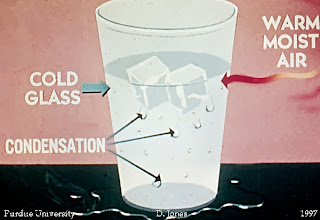
    Condensation is when gas changes to liquid. For example, when there is a cup of water, and if you put in your room, the surface of the water bottle will have drops of water sticking on the side. The water on the side of the cup is happened because of the gas around the cup.
    Deposition is when gas changes to solid opposing sublimation. When the when the vapor on the air changes to frost, that is deposition. You can see this in the morning at cold area.


    It is not true if you think all the matter has the same boiling point and melting point. Water is just one good example. Dry ice is the state of solid of carbon dioxide. In the case of dry ice, this changes to gas(sublimation) in the temperature of 25°C, not 0°C. So you need to remember that not all the matter has the same boiling point and melting points.

    DONE!!!!!!!!!!!!!!!!SEE YOU NEXT WEEK!